
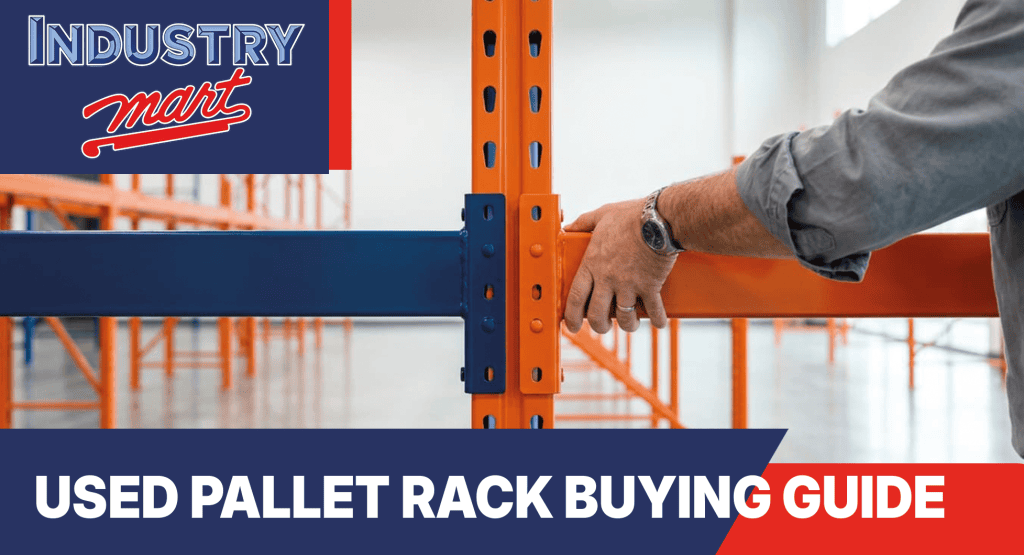
Used rack is cheap steel and expensive mistakes, and the line between them gets drawn before the money moves. One buyer walks the lot with a phone camera and a short list of questions, and gets a system still standing when the lease renews. Another sees a price per bay and wires a deposit, then finds out the lot will not match anything, including itself. Same lot, two outcomes.
Key Takeaways
- Whether you are matching an existing system or starting fresh changes the entire checklist. Answer that first.
- The punch pattern on the upright names the manufacturer, and the manufacturer is what gets you the capacity chart.
- Parts from different makers often fit each other. Fitting is not the same as being rated.
- Freight, hardware and installation eat the savings quietly. Price the delivered and standing system, not the bay.
- Four photos will screen a lot before you drive to it: the upright punch, a beam connector, a base plate, and a full bay standing.
Matching or Starting Fresh Changes the Whole Checklist
There are two kinds of used rack buyers. One has rack standing and wants more. The other has an empty building and a budget.
If you are adding to an existing system, compatibility outranks everything. Upright depth and height, beam length, beam face height, connector style, clip type, load rating and bay spacing all matter. Start by identifying what you already own: the punch pattern on your upright column identifies the manufacturer, and a photo of one connection is usually enough for a dealer to confirm or rule out a match.
Compatibility has a second half that catches people. Parts from different manufacturers often do fit, because teardrop punches are close enough across the major brands that a beam from one seats in a column from another. What does not transfer is the engineering. Each manufacturer tests its own components as a system, and mixing parts from different rack systems invalidates the load testing behind both of them. A beam that drops in is not evidence that the bay is rated.
If the building is empty, you are free of that problem. One lot out of one facility closure gives you the best odds on consistency, and this state produces more of those lots than most: Tennessee’s economic development department counts over 316,000 people in distribution and logistics here, second in the country, and that much warehouse footprint turns over constantly. Best odds are still odds, though, because big buildings accumulate rack across decades and often hold two or three systems. So ask the seller what separates the two cases: did this all go in at once, or did it arrive over the years?
What to Check When Buying Used Pallet Rack, Cheapest Check First
Start with photographs. They are free and they kill bad lots before you spend a day driving. Ask for four: the upright punch up close, a beam connector seated in a column, a base plate, and a wide shot of a full bay standing. A seller who will not send four photos is telling you something.
Then the steel itself. Columns should be straight, and a bent one is not a negotiating point, it is a reason to walk. Beams should not be twisted or bowed. Connectors should be square, since a deformed one will not seat properly no matter how good the column is. Base plates should sit flat with the column square on them, anchor bolts in place, no corner lifting off the floor. Surface rust is cosmetic on most lots. Pitted or flaking rust that has eaten into the steel is not. Welded repairs on a column are a walk away unless paperwork comes with them: the ANSI MH16.1 standard calls for a repaired rack to be restored to its original design capacity and certified by a licensed professional engineer, and almost no used lot carries that certificate.
Then the paperwork, last to check and first to hurt you. Two questions for the seller:
- Who made it? The punch pattern answers this, and the answer gets you the capacity chart.
- What is it rated for, at the beam spacing you plan to use? Capacity changes with vertical spacing, so a rating without a spacing attached is not a rating.
Both are answerable from the photos you already asked for, and a seller who cannot has not looked at the lot. The third goes to you, and it is the one buyers skip: at what beam spacing are you going to load this rack, and do you know that number before you pick up the phone?
The Costs That Are Not the Price
Freight is the one that surprises people most. Rack is long, heavy and awkward, and how tightly the uprights nest decides how many bays fit on a trailer, so upright depth and beam length move the freight number as much as bay count does. A lot three states away at a good price per bay can land above one an hour away, so get the delivered number before you compare anything.
Hardware is the quiet one. Used lots routinely arrive short on safety clips, anchor bolts and row spacers, the parts that hold the system together. Count clips against beam levels before you accept the lot, not after the truck leaves.
Installation is the third. Teardrop, the roll-formed style with hook-in beam connectors, goes up fast. Structural takes bolts and time, and a mixed lot takes longer than either because the crew is sorting parts first. We carry pallet rack new and used, and our installation crew installs across Tennessee and the Southeast.
When Buying Used Pallet Rack Is the Wrong Call
Used pallet rack stops being the obvious answer in a few specific places. Cold storage, where the finish does real work against condensation and a used lot rarely arrives with one you can trust. Loads at the edge of a rating, where you want steel whose history you can see, because a used column has absorbed hits nobody wrote down. Small additions, where a two bay order carries the same freight problem as a fifty bay order without the volume to absorb it. And seismic sites, not a flat no but the case where the engineering bill can eat the savings, because anchorage, base plates and bracing have to be designed for your building rather than the one the rack came out of.
The steel is the cheap part in all four. Everything that has to be true around it is not. Have you priced that side yet?
Frequently Asked Questions
Does used rack come with a capacity chart?
Often not, and it is worth chasing hard. The path runs from the punch in the column to the manufacturer to the chart they published, and it dead ends on steel from makers that no longer exist. That is the point to walk away or budget for an engineer.
Can I mix rack from different manufacturers?
The parts will often fit. The ratings do not travel with them, so a mixed bay is an untested bay.
What if the seller does not know the capacity?
Then you have an unrated system. Identify the manufacturer from the punch and pull the published chart, or hire an engineer to rate it. Loading it on an assumption is the one corner here that can hurt somebody.
Is rust a dealbreaker?
Surface rust on an otherwise straight column is normal and not by itself a reason to walk. Rust that has pitted or flaked the surface has removed material, and a column with less steel in it is not the column the chart was written for. Look hardest at the base of every column, where forklift traffic strips paint and moisture gets in behind it.
Buy From Somebody Who Keeps Both on the Floor
IndustryMart has been selling new and used rack in Tennessee for over forty-five years, and the Cookeville showroom runs 30,000 square feet you can walk through, the quickest way to see what you give up and what you do not. We buy used rack too, so the lots we sell are lots we chose to take.
Send us photos, or tell us the building and the load. Ask for a quote on used pallet rack or call 931-537-3161 and we will tell you what fits.
Get the Four Photos Before You Send Money
Before the money moves on any used lot, get the four photos and ask who made it. Clean photos and a manufacturer name mean you are buying steel. A vague answer means you are buying a problem.
A discount you cannot stand up is not a discount.
Related Articles
- Selling Used Pallet Rack: What It Is Worth and How the Process Works, the same transaction seen from the other side of the table.
- Pallet Rack Weight Capacity: What Your Beams Can Really Hold, on reading a capacity chart and a load plaque once you have one.