
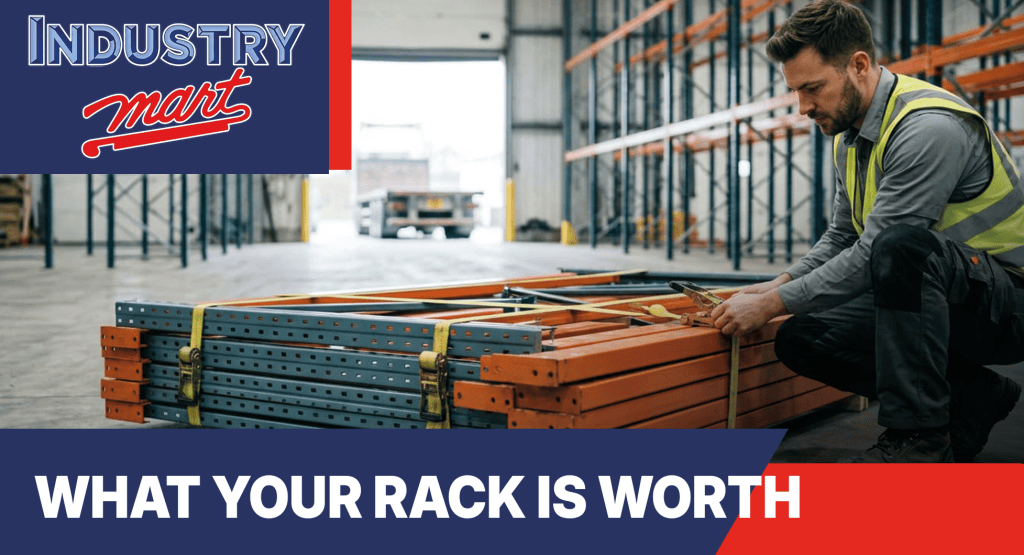
Nobody plans to sell used pallet rack. It happens because a lease ended, a building sold, or the operation moved and the steel did not fit the new footprint. Whatever brought you here, the rack in that building is an asset, and the number somebody offers for it is not arbitrary. Here is how that number gets built.
Key Takeaways
- Teardrop sells. Odd connection styles mostly do not.
- The offer is resale value minus the cost of getting the steel out of your building. That subtraction is the part most sellers never see coming, and it is bigger in a hard building than in an easy one.
- Matched lots beat mixed piles.
- Scrap price is the floor. Rack that cannot be resold is worth its weight in steel and nothing more.
What Actually Determines the Offer
Four things decide most of it. Connection style comes first, because teardrop is the closest thing this industry has to a universal standard and a buyer can move it to almost any customer. Brand matters next: Interlake, Republic, Ridg-U-Rak, Unarco, Speedrack and Paltier are names a dealer can quote with confidence because capacity charts exist for them.
Then quantity and consistency. Forty uprights of the same height and depth with beams to match is a system somebody can install. The same forty uprights in six different heights is a parts pile, and it gets priced like one.
Condition is the fourth, and it is less forgiving than people expect. Surface rust and scuffed paint are cosmetic and barely move the number. Bent columns, torn teardrop holes, welded repairs, and missing footplates move it a lot, because that steel cannot be resold to a customer who has to load it.
Two things worth knowing before you count anything:
- Uprights carry most of the value. Beams are worth less per piece and there are always more of them.
- Wire decks, footplates and row spacers sell alongside the rack. Leave them out of the count and you are giving them away.
What Takes Value Off the Table
Damage is the obvious one, but it is worth being specific about what a buyer is looking at. Rack that has been hit by a forklift is not automatically scrap, though a column with a visible bend cannot go back into service without engineering review, and most dealers will not take that risk on resale. The same applies to holes that have been torn or elongated by a beam that dropped.
Modified rack is the quieter problem. Uprights cut down to fit a lower ceiling, beams drilled for something they were never made to hold, frames spliced from two different systems. All of it works fine in your building and none of it can be sold with a capacity rating attached. If you are unsure what condition your system is actually in, a rack inspection answers that question before you ever ask for an offer.
The last one is location. Rack in a building with dock access, clear aisles and a working forklift is cheaper to remove than rack in a basement, behind a low door, or under a sprinkler system that has to be worked around. That cost lands in the offer.
Two conditions that turn a good lot into a scrap lot:
- Mixed connection styles across the same system, so nothing interchanges.
- No way to identify the manufacturer, which means no capacity chart and no resale.
The Number Nobody Mentions Until the Walkthrough
Teardown labor. Your rack has to come apart, get stacked, get bundled, get loaded on a flatbed and leave the building, and somebody pays for that. In an honest offer it is subtracted from the resale value and shown to you. In a bad offer it appears late, after you have already cleared your schedule around a pickup date.
This is also why the same rack is worth different amounts in different buildings. A hundred bays on a clean slab with dock doors and 30 foot aisles comes out fast. The same hundred bays wrapped around a mezzanine, with product still on half of them, takes days and a bigger crew. The steel is identical. The net is not.
And there is a floor under all of it. Federal reporting put No. 1 heavy melting steel scrap at an average of $325 per metric ton across 2024, down from $424 in 2021, and that is what rack is worth when nobody will resell it. Check the current number before you accept an offer near the floor, because it moves month to month. Everything above that number comes from the rack being usable, identifiable and worth reinstalling. Tell us what you have and we will price it.
How the Process Runs
It starts with information, not a visit. A buyer needs quantities, upright heights and depths, beam lengths, connection style and honest condition notes before anybody drives anywhere. Photos do more work than descriptions here: a wide shot of the aisle, a close shot of an upright connection, and one of any damage you already know about.
From there you get an offer, usually with the removal cost stated separately so you can see both halves. If it works, a date gets set. The crew dismantles, stacks, bundles and loads, and the steel leaves on flatbeds. Payment terms get agreed before the crew shows up, not after.
The part sellers control is the first step. Most people who set out to sell used pallet rack open with a vague message describing a warehouse full of steel, and a vague message gets a vague answer and a slower process. Counts and photos get a real number.
Two measurements to take before you contact anyone:
- Upright height and depth, plus how many of each size you have.
- Beam length and face height, plus the count per size.
Frequently Asked Questions
How much is my used pallet rack worth?
It depends on connection style, brand, quantity, condition and how hard the building is to work in. Teardrop in matched sizes and good condition carries real resale value. Off-brand rack in mixed sizes with damage often nets close to scrap once removal is priced in. Nobody can give you a number without counts and photos, and anyone who does before seeing them is guessing.
Do I have to take the rack down myself?
No. Most sales include dismantling and removal by the buyer’s crew, with that labor reflected in the offer. Taking it down yourself can raise your net if you have the equipment and the people, but rack teardown is a fall and crush hazard and it is not a job for a warehouse crew that has never done it.
What if I do not know what brand my rack is?
That is normal and it is usually solvable. The connection punch on the upright column is the identifier, and a clear photo of it is often enough. Our Rack ID Guide covers the common patterns.
Will anybody buy a small quantity?
Sometimes, though economics work against it. A handful of bays may not cover the cost of sending a truck, so small lots do better bundled with other equipment or dropped off if you can move them yourself.
How long does the whole thing take?
Days to a few weeks, depending on size and access. The offer stage moves fast when you send good information up front. Scheduling the crew and the trucks is what sets the timeline.
Talk to Somebody Who Buys This Every Week
IndustryMart has been buying and selling rack in Tennessee for over four decades, and what we buy is what we resell out of a 30,000 square foot showroom in Cookeville. That is the difference between a liquidator and a dealer: we are pricing your steel against what we know it sells for, because we are the ones who will sell it.
Send counts, sizes and photos through the We Buy Rack form or call 931-537-3161 and we will walk through what you have.
Count It Before You Call
Walk the aisles with a tape measure and write down upright heights, upright depths, beam lengths and counts for each. Photograph one upright connection up close and any damage you can see. That single page of notes is the difference between an estimate and an offer.
The steel does not get more valuable sitting in an empty building. It gets more valuable when somebody knows exactly what it is.
Related Resources
Not sure what you are looking at? Our Rack ID Guide and Measuring and Sizing references cover the connection patterns that identify a manufacturer and the measurements a buyer will ask for.