
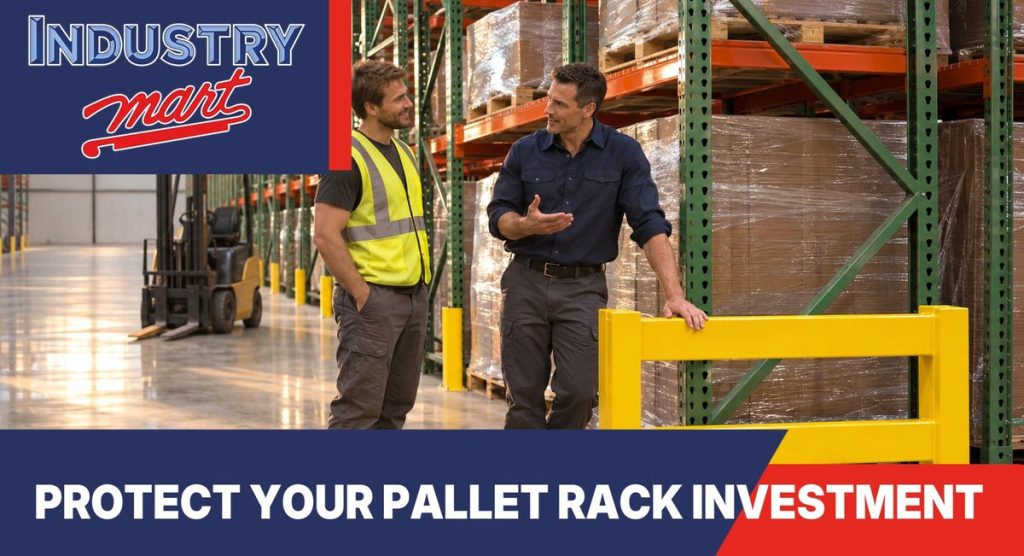
Forklifts and rack share the same aisles all day.
Most of the time they get along. Then a driver cuts a corner at the end of a row, or backs out of a bay a little crooked, and the forks catch the front column of an upright. Nobody writes it up. The dent is a few inches long. The bay goes back into service because the rack is still standing, and that is how a column with a fraction of its rated strength ends up holding four full levels.
Pallet rack protection is the inexpensive steel that takes that hit instead of the rack: post protectors on the front columns, guards at the ends of rows, and backing that keeps product from falling into the aisle behind. Here is what each one does, where it goes, and why it costs a fraction of the repair it prevents.
Key Takeaways
- Most rack damage starts low, on the front columns, where forks and wheels hit.
- Post protectors guard the column. End-of-row guards guard the whole end frame.
- Rack backing protects the people on the other side of the rack.
- Protection costs less than one bay out of service.
What a Forklift Hit Costs Without Pallet Rack Protection
A damaged upright is not a cosmetic problem. Under ANSI MH16.1, the industry standard for steel storage rack, damage beyond the manufacturer’s limits means the bay comes out of service until it is repaired or replaced. That means unloading every level of the bay, and often the bay next to it, because the beams tie into the same frame. Then the frame is repaired or replaced, and the bay is reloaded.
The frame itself is the cheap part. The real bill is the labor to unload and reload, the forklift time taken off the floor, the pallet positions that sit empty while the repair waits on parts, and the risk carried in the meantime if nobody noticed the dent. Forklifts are also dangerous on their own: federal data shows 614 workers died in forklift-related incidents from 2011 to 2017, and 12 of the 74 forklift deaths in 2017 came from being struck by a falling object.
Two numbers to compare before you decide protection is optional:
- what a post protector costs per column
- what one day of a bay out of service costs your operation
Post Protectors: The Front Columns
Post protectors, also called column guards, are the most common piece of pallet rack protection and the one most warehouses need in the most places. They wrap the bottom of the front column, the side that faces the aisle, and take the impact a forklift would otherwise put into the upright. Some are bolted to the floor and stand free of the column, so the guard and the slab take the hit instead of the column. Others clip or bolt onto the column itself and spread the impact.
Floor-mounted guards protect better in busy aisles because the impact stays off the column. Column-mounted guards are faster to install and work where the floor is tight or the traffic is light. Either way, height matters: the guard has to cover the zone where forks and wheels actually make contact, usually the first 12 to 24 inches.
Where to start if the budget only covers part of the building:
- every front column at aisle intersections and turn points
- every column in the aisles with the most pallet moves per shift
End-of-Row Guards: Where the Big Hits Happen
The end of a rack row is the most exposed frame in the building. Every forklift that turns into or out of that aisle passes it, usually while turning, often while carrying a load that blocks part of the view. A post protector covers one column. An end-of-row guard covers the whole end frame.
These are heavy steel rails, bolted to the floor across the end of the row and set a few inches out from the frame, so a turning truck hits the rail before it reaches the rack. Some are single rails, some double. Where the traffic is heavy, many operations add a post protector on the end columns as well, because a guard that covers the end does not cover the corner column from the side.
End-of-row guards, post protectors and row spacers are all part of the pallet rack accessories we stock, sized to fit the frames they protect. If you only protect one spot in the building:
- every row end on a main travel aisle
- every row end where trucks turn blind
Rack Backing: The Aisle Behind the Rack
Post protectors and end guards protect the rack. Rack backing protects people. It is a wire mesh panel or netting attached to the back of a rack row, and it stops cartons, partial loads and pallets that get pushed too deep from falling out the back.
That matters most where the back of the rack faces a walkway, a work area, a packing line or another aisle. A forklift putting a pallet into a front bay can push the load behind it right off the rear beam, and nothing stops it but the backing. Wire decking on the levels keeps product from falling through, and backing keeps it from falling out the back. The two work together, and neither one replaces loading every level within its rated beam capacity.
Put backing here before anywhere else:
- rack that backs onto a pedestrian walkway or a staffed work area
- upper levels holding loose cartons or partial pallets
Frequently Asked Questions
Do I need post protectors on every column?
Not usually. Front columns facing forklift aisles need them first, starting at row ends and the busiest lanes. Back columns in a back-to-back row face the flue and are rarely hit, except at the row ends and on single rows that back onto an aisle.
Can I straighten a bent upright instead of replacing it?
No. Take the bay out of service and have the damaged frame repaired or replaced according to the manufacturer and the standard, then reload it.
Is a guardrail the same as an end-of-row guard?
Not quite. An end-of-row guard protects a rack frame from a turning truck. A guardrail separates a walkway, an office or a dock area from forklift traffic, and it may run along the side of a row rather than across the end.
Do protectors work on used rack?
Yes, as long as the guard fits the column size and the frame is straight and undamaged to start with. A guard on a column that is already bent protects a problem, not a rack.
Does rack backing affect sprinklers?
Mesh backing lets water through, but check with your fire marshal or sprinkler designer before adding any backing to a sprinklered system.
Protect the Rack When You Buy It
Industry Mart has stocked pallet rack and the accessories that keep it in service since 1979, out of an almost 100,000-square-foot warehouse in Cookeville and a 30,000-square-foot showroom there. Its crew installs rack across Tennessee and the Southeast under its Tennessee general contractor license (#86487), so protection can go on the order and in the same installation.
Tell us how many rows, how many aisles and where people walk. Get a quote on pallet rack protection or call 931-537-3161.
Start at the Ends of the Rows
Walk the building and mark three things: every row end, every front column on the busiest aisles, and every place where the back of a rack faces people. Put end-of-row guards on the first, post protectors on the second and backing on the third. Then add protection to the next order of rack, not after the first hit.
Related Articles
- Pallet Rack Installation: When DIY Works and When You Need a Pro Crew, for setting guards and anchors along with the rack.
- What Depth Pallet Rack Do You Need? The 48-Inch Pallet Mistake, for the overhang that puts pallets close to the aisle.
- R-Mark Certified Pallet Rack: What It Means and Why It Matters Before You Buy, for the rack you are protecting.