
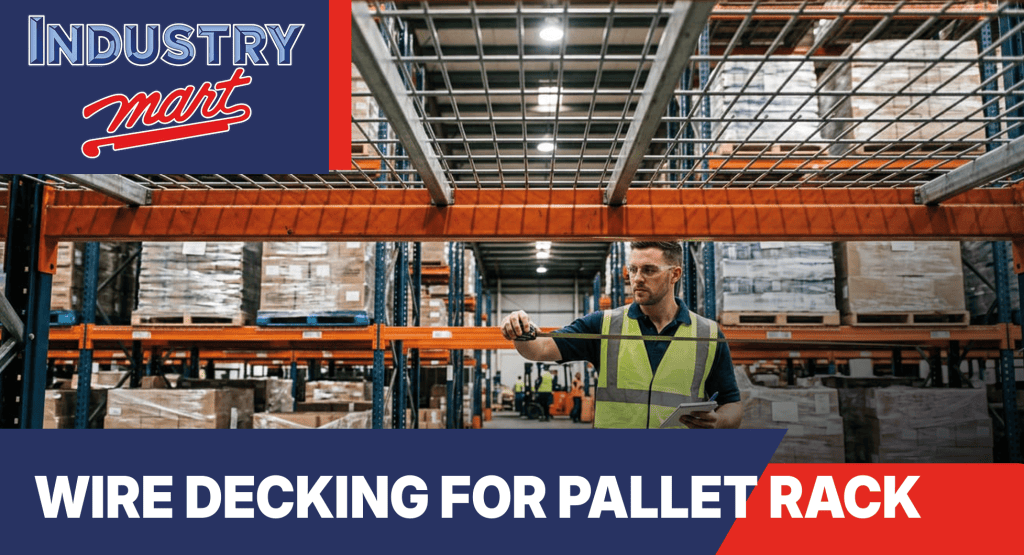
Wire decking is the part of a rack system that gets ordered last, priced by the piece, and blamed first when a pallet with a broken board drops a case through the beams. It is also the part people size by guessing. A deck is sold by depth and width, the depth has to match the upright, the width has to divide into the beam, and the channels underneath have to sit on the beam you actually own. Get one of those wrong and the deck either does not fit or does not carry what the label says.
This is the working reference for pallet rack wire decking sizes: how the numbers on a spec sheet map to the rack on your floor, what the capacity rating means and does not mean, and which channel style goes with which beam. It serves the person replacing a hundred decks in an existing system as well as the one equipping a new one, because the two make the same mistakes in opposite order.
Key Takeaways
- Depth matches the upright. Width divides into the beam.
- The deck is narrower than the space it fills. That is why standard widths are 46, 52 and 58, not round numbers.
- Capacity is a uniformly distributed number. A point load in the middle of a 2,500 pound deck is a different question, and usually a smaller answer.
- Step channels fit step beams. Flared channels fit almost anything.
How the Numbers on the Spec Sheet Work
A wire deck is described depth by width. Depth runs front to back and matches the upright frame depth, so a 42 inch frame takes a 42 inch deck. Standard depths run 24, 36, 42, 48, 60 and 72 inches, with 42 and 48 accounting for most of what ships.
Width runs along the beam, and this is where people get it wrong, because the deck is narrower than the space it fills. A 96 inch beam does not take two 48 inch decks. It takes two 46s, with the difference absorbed by the connectors and the gap between panels. The mapping is simple once you see it: a 48 inch beam takes one 46, a 96 takes two 46s, a 108 takes two 52s, a 120 takes two 58s, and a 144 takes three 46s. A 102, which shows up in older systems, takes one 52 and one 46.
Two measurements to take before you order anything:
- Upright depth, measured across the frame from the outside of one column to the outside of the other.
- Beam length, measured from the inside face of one upright to the inside face of the next, not from the end plates.
What the Capacity Rating Actually Means
A standard deck, 42 by 46 with three support channels under a 2.5 by 4 inch mesh in 6 gauge wire, is typically rated around 2,500 pounds. Four channels push that toward 3,000 to 3,500 on the same footprint. Those numbers come with two words that matter more than the number: uniformly distributed. The rating assumes the load is spread across the whole panel, which a full pallet does and a single drum, a machine base or a stack of dies does not.
The rating is also not a rating for the level. A beam pair carries its own capacity, and the lowest number in the assembly governs. Two 2,500 pound decks on a beam level rated for 4,000 pounds is a 4,000 pound level, not a 5,000 pound one.
Deck strength lives mostly in the channels, not the mesh. The mesh keeps product from falling through; the channels carry the weight to the beams. When you compare pallet rack wire decking sizes across suppliers and the capacities differ for the same footprint, channel count and gauge are usually why.
Two things to check on the rating before you trust it:
- That it says uniformly distributed, and that your load is.
- That the beam level it sits on is rated at least as high, because it is the ceiling either way.
Match the Channel to the Beam Before You Match the Size
The support channel is the part of the deck that touches the beam, and it comes in a few shapes for a reason. Standard step channels are formed to sit down into the 1-5/8 inch step on a step beam, which is what most teardrop rack uses. On a step beam they sit flush and the deck surface ends up level with the top of the beam.
Put that same step channel on a box beam or a structural channel beam and it has no step to sit in, so it rides high and loose. That is what flared channels are for. The flare spreads the channel end so it seats on either profile, which is why they are sold as universal fit and why they are the safe choice when a warehouse runs more than one rack brand. Lay-in or inset decks are the third option, sized to drop inside a box beam and rest on its inner lip.
Then there is the front edge. A waterfall deck bends the mesh down over the beams, typically an inch and a half, which locks the panel in place and covers the beam face. A flat or inside waterfall deck stops short and leaves the beam face clean for labels and scanning. See the wire decks and crossbars we stock, along with the row spacers, post protectors and guards that go on the same order.
What Decking Does Besides Hold Weight
Decking is inexpensive relative to the rack it sits on, and its job is mostly to keep things from falling. Federal injury data for 2023 and 2024 puts contact with objects and equipment at 860,050 cases involving days away from work, job restriction or transfer in private industry, second only to overexertion. Product coming off a rack level is one way a warehouse lands in that category, and a surface under a pallet with a broken board is a cheap answer to that specific piece of it.
Open mesh does two other jobs. It lets light through, so upper levels are visible from the floor, and it lets water through, which is why many local fire codes call for it instead of plywood on sprinklered racks. Local code decides that, not the deck supplier, so the fire marshal is the right call before anyone orders solid decking for a sprinklered building.
Wire decks also go on wide span shelving in place of particleboard, sized the same way, depth to frame and width to beam, with flat channels for those systems’ flat beams.
Two situations where wire is the wrong deck:
- Small loose parts that fall through a 2.5 by 4 mesh, which want solid or perforated steel.
- Wire containers and totes with narrow feet that concentrate load on a few wires, which want bar grate.
Frequently Asked Questions
My beam is not a standard length. What do I order?
Measure the clear span between uprights, subtract about two inches for the connectors, and split what remains into two or three panels of the closest stock width. Odd lengths from older or imported systems often take a mixed pair, such as one 52 and one 46, and the supplier can confirm the pair from the beam length alone.
Can I use one wide deck instead of two?
Usually not worth it. Wide single panels are heavy to handle, harder to ship without damage, and the two-panel layout is what suppliers stock and price best.
How much weight can a wire deck hold?
Around 2,500 pounds uniformly distributed for a standard three-channel deck, with four-channel decks rated higher.
Do I need wire decking if I only store pallets?
Not for capacity, since a good pallet spans the beams on its own. You need it for the day the pallet is not good. A pallet turned the wrong way, a partial load shifted to one side, or product hanging past the stringers is what decking catches, and most warehouses meet that pallet eventually.
Is used wire decking worth buying?
Yes, when the channels are straight and the welds are intact. A scuffed deck carries what a new one does. A deck with a bent channel or broken welds does not, no matter how it looks from above, so used decking gets checked underneath first.
Talk to Somebody Who Stocks Wire Decking
IndustryMart has been outfitting Tennessee warehouses since 1979 out of a 30,000 square foot showroom in Cookeville, with the area’s largest in-stock inventory of new and used equipment. In-stock material is available for pickup Monday through Friday or delivery, with regular runs into Kentucky, Alabama, North Georgia and North Carolina.
Send us your upright depth, your beam length and a photo of the beam profile. Ask for a quote on wire decking or call 931-537-3161 and we will confirm the size and channel style before you order.
Measure Twice, Then Order by the Level
Write down the upright depth and beam length for each distinct bay size in the building, because older systems often have more than one. Note whether the beam is step, box or structural. Count levels, not decks, and let the width mapping tell you how many panels each level takes. Then decide waterfall or flat based on whether you label the beam face.
Order from that sheet. Decks bought by the pallet load without it are the ones that come back.
Related Articles
- Teardrop vs Structural Pallet Rack: Which One Fits Your Warehouse, on the beam types that decide which channel style your decks need.
- Selling Used Pallet Rack: What It Is Worth and How the Process Works, on why decks should be counted and sold with the rack rather than left behind.