
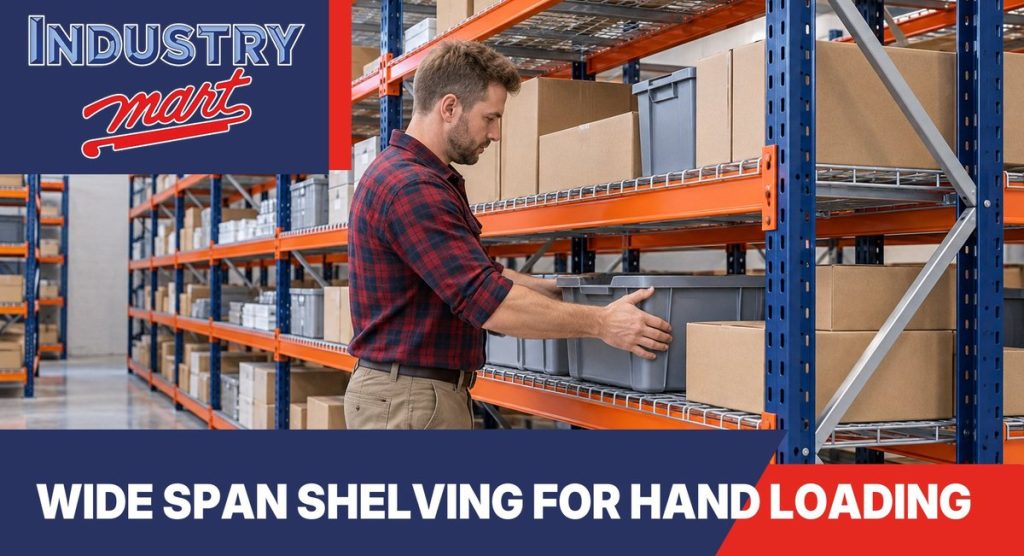
Somewhere between the rivet shelving in the back office and the pallet rack on the warehouse floor sits a storage problem nobody budgeted for. The cartons are too heavy and too big for light shelving, the people handling them have no forklift, and a pallet rack level four feet off the floor turns every pick into a stretch or a squat.
Wide span shelving was built for exactly that gap. It borrows the frame of pallet rack and the loading habits of shelving, and once you know how to size it, it handles the boxes, bins and bulky parts that wear out everything lighter. This is how to choose it, measure it and load it so the people doing the lifting are not the weak point.
Key Takeaways
- Wide span is pallet rack’s lighter cousin, loaded by hand from either side. No forklift, no pallets.
- Our wide span carries up to 1,400 pounds per shelf level, depending on size and decking.
- Depth follows the product, width follows the longest item, and height follows the people doing the picking.
- Wire decking or full-width particle board, chosen by what sits on the shelf.
- Put the heavy cartons in the middle levels. The top shelf is for the light stuff.
What Wide Span Actually Is
Picture a scaled-down pallet rack. Upright frames with bracing, horizontal beams that lock into the frames without bolts, and a deck laid across the beams. The difference is the job. Pallet rack levels are set for pallets and a forklift. Wide span levels are set for a person standing in the aisle, loading from either side by hand.
That gives it two advantages over light shelving: longer clear spans between frames, so bulky items fit without a post in the way, and heavier capacity per level. Compared with pallet rack it gives up capacity and the forklift. Wide span is not built to be loaded or bumped by one, and treating it that way is how a shelving system gets bent.
So what is in your aisle today, and who loads it?
Where It Earns Its Place
The typical wide span job looks like this: cases of product broken down from pallets and picked by hand, maintenance spares and motors in a shop, archive boxes in a records room, bins of fittings at a parts counter. The common thread is a carton heavy enough to bow a light shelf and light enough that nobody wants a forklift for it.
Before any of this comes one question: does a hand or a fork touch the load? If the answer is not obvious yet, the comparison of boltless shelving against pallet rack is the first cut. Wide span makes sense once the answer is hands and the weight has outgrown a light shelf. Lighter loads belong on our industrial shelving line.
Wide span is built for exactly those jobs: tools, inventory, supplies and archive storage.
Size It in Four Measurements
Wide span comes in standard sizes, and picking the right one is a short sequence.
- Depth. Measure the deepest item you will store and pick the next standard depth up. Our standard depths run 18, 24, 36, 42 and 48 inches. Deeper is not better if people have to reach past the front row to get to the back.
- Width. Standard widths are 48, 60, 72, 84 and 96 inches. Wider spans fit long or bulky items and need fewer frames in the row, at a lower rating per level.
- Height. Frames run from 4 feet to 26 feet. For hand picking, the levels people use every day belong between knee and shoulder. Anything above reach becomes overstock that needs a ladder or work platform.
- Deck. Wire or full-width particle board, covered below.
Levels and unit count are arithmetic after that. Which of the four have you actually measured?
Load It So the People Last Longer Than the Steel
Hand-loaded storage moves the weight onto people, and the federal ergonomics researchers at NIOSH built an equation for how much is too much. Their formula starts from 51 pounds under ideal conditions and cuts that figure as the lift gets worse, and the height of the hands above the floor is one of the variables that sets the recommended weight limit. A carton lifted from the floor or reached for overhead is a harder lift than the same carton near waist height.
Shelving is the cheapest place to act on that. Put the heaviest, most-picked cartons on the middle levels, the light and slow-moving items up top, and nothing heavy on the floor level that someone has to squat for. Because wide span loads from either side, two pickers can work the same unit from opposite aisles. That either-side access is part of how our wide span shelving for hand-loaded storage is designed.
Wire or Board: Choosing the Deck
The deck choice is about what touches it. Bins, cases and boxed parts sit happily on wire decking, which lets light and sprinkler water through and collects less dust, so wire is the better pick anywhere those matter. Loose small parts, files and anything with a narrow foot that can drop between wires does better on full-width particle board.
The weakness to plan for first with particle board is water. In a damp room or near a dock door, board swells and sags where wire does not. If the room has a sprinkler system, check with your fire marshal before you cover a whole run in solid decks.
Which matters more in your room, flat surface or open air?
Frequently Asked Questions
Can I put a pallet on wide span?
No. Wide span is built for hand loading, and pallets mean forklifts. If a forklift is part of the job, that bay should be pallet rack.
How much does one level hold?
The ceiling on our wide span is 1,400 pounds a level, and the real rating for your unit comes from its beam length, beam size and decking. A 96-inch span carries less per level than a short one built from the same beam, and the deck has its own rating. Ask for the rating on the exact size you are buying, and post it on the unit so the next person who loads it knows the number too.
Is it hard to put together?
The design is bolt-less: the beams hook into the uprights, so there is no hardware to tighten level by level.
Can I add levels later?
Yes, as long as the frames have the height. Extra beams and decks have to match the frames you already have, so note the maker and sizes before you shop.
Bring Us Your Heaviest Carton
IndustryMart has been in business since 1979, selling new and used rack and shelving. Customers can see samples in the 30,000-square-foot showroom in Cookeville, an almost 100,000-square-foot warehouse in Cookeville is the heart of the operation, and the company installs across Tennessee and the Southeast.
Tell us what you store, the heaviest carton and how high your people can comfortably reach. Ask for a quote on wide span shelving or call 931-537-3161.
Measure Before You Order Wide Span Shelving
Take the deepest item, the longest item and the heaviest carton, and note who will be loading the shelves and how often. Those numbers pick the depth, the span, the deck and the levels, and they keep the heavy work near waist height where it belongs.
Shelving holds the inventory. The layout decides whether it holds up the people too.
Related Articles
- Pallet Rack Wire Decking: Sizes, Capacities, and How to Choose the Right Deck, for the deck side of the decision.
- Liquor Store Shelving Layout: How to Plan a Store That Sells More, for hand-loaded shelving in a retail setting.