
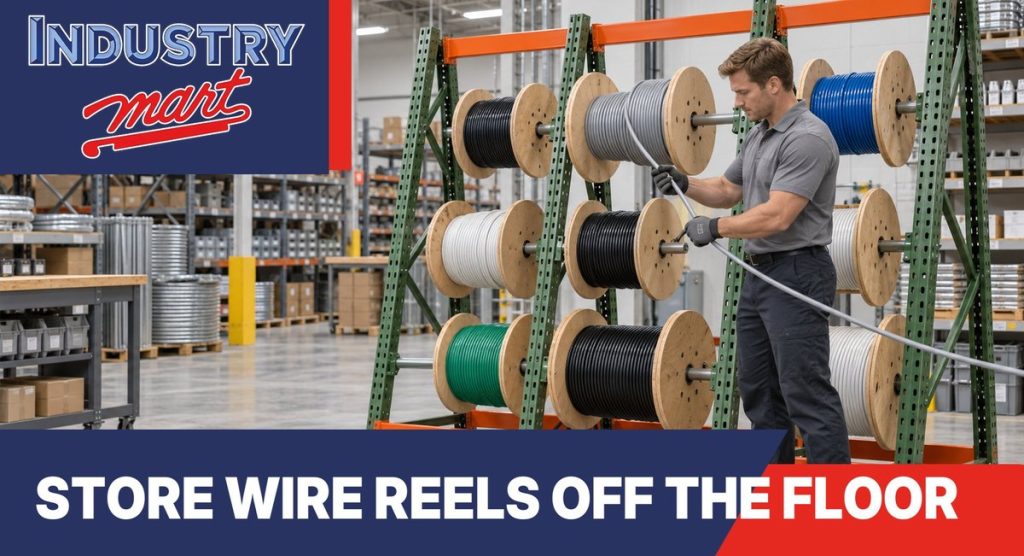
Walk into most electrical supply rooms and the reels are standing on the floor in a loose crowd, a few rolled against the wall, one leaning on a column, a half-used spool of 12-gauge blocking the path to the one somebody actually needs. Every reel on the floor takes a footprint, an access lane and a forklift trip to move it, and the cable on it is one bad roll away from a crushed jacket. A cable reel storage rack fixes all three at once, if you pick the type that matches how the cable leaves the building.
Key Takeaways
- Reels belong on their flanges or on a bar, never flat.
- Bar racks let you pull cable straight off the rack.
- Choose by how the cable leaves: cut lengths at the rack, or whole reels out to the job.
- Size the rack from your largest flange diameter and your heaviest full reel, not from the average.
What Floor Storage Really Costs
A reel standing on its flanges needs its own patch of floor plus room to get at it, and reels do not nest the way pallets do. Ten reels in a row against a wall can eat the same square footage as a full bay of pallet rack holding many times the product, and the reel you need is always the one in the back.
The cable pays for it too. A reel rolled across concrete to reach a neighbor picks up grit on the flanges and knocks into whatever sits in its path, and a reel that gets tipped onto its side is a reel General Cable says should not be stored that way at all. The same guidance calls for reels to stay upright on a flat, hard surface and says plainly that reels must not be stacked.
Then there is the time. Every pull from a floor reel starts with finding it and ends with putting it back somewhere it fits. Shift after shift, that is labor spent on logistics instead of on the cut.
The Three Ways a Rack Holds a Reel
Most reel racks come down to one of three ideas, and the right one depends less on the reel than on what you do with it.
| Rack type | How it holds the reel | Fits best |
|---|---|---|
| Bar or axle rack | A steel bar runs through the arbor hole and rests in slots on the uprights | Cutting lengths at the rack from many smaller reels |
| Roller or cradle rack | The flanges sit on rollers, so the reel turns without a bar | Heavy reels that are awkward to lift onto a bar |
| Upright in a rack bay | The reel stands on its flanges on a deck, chocked so it cannot roll | Full reels that leave whole for a job site |
The bar rack is the one most supply houses picture, because it turns the rack into a dispensing station: pull the end, measure, cut, and the reel never moves. The trade-off is lifting. Every reel has to get up to bar height with a bar through it, which is manageable by hand for a light spool and a forklift job for a big one.
Rollers ease the lifting for heavy reels, since nobody threads a bar and the reel only has to be set down. Standing reels upright in a bay is the plainest option of the three and the right one when reels leave full, because nobody cuts from them in the building.
Get the Reels Off the Floor and Keep Them on Their Flanges
Whatever rack you choose, the reel stays upright. That is not a rack salesman’s preference. Utilities write it into their own handling procedures: the City of Longmont’s electric utility, for one, calls for reels to rest on the flange edge and states that storing reels flat, with the flanges horizontal, is not acceptable, and lists stacked reels as unacceptable too.
A bar rack makes that rule automatic, because a reel on a bar cannot lie flat. Cable reel racks are among our specialty racks for jobs where standard pallet rack is not the best fit, and our team can help you work out what fits your reels.
Sizing a Reel Rack Without Guessing
Start with the biggest reel you stock, not the typical one. Its flange diameter sets the vertical space each level needs and the clearance between bars, and its full weight, times the reels sharing a bar or level, sets what each bar or level has to carry. A rack sized for the average reel leaves the biggest one back on the floor.
Width comes next. On a bar rack, the overall width of each reel, flange to flange, plus hand room on each side, decides how many reels share a bar. Then count how many different cables you keep on hand and how often each one gets cut, because the fast movers belong at waist height where nobody needs a lift to reach them.
Loading is the last question and the one that gets skipped. If reels arrive on a forklift, the rack has to leave room for the forks to set a reel down square to the flanges. General Cable’s guidance says a forklift should lift a reel at a right angle to the flanges and that the forks should never touch the cable itself, a rule that is much easier to keep when the rack was laid out for it.
Where Reel Racks Sit in the Building
A reel rack wants to live near the cutting table and the door the cable leaves through, not in the back corner where the floor reels used to collect. Conduit and pipe usually come in from the same suppliers and go out on the same trucks, and contractors who store long material on cantilever arms sized for pipe and conduit often put the reel rack right beside it, so a job gets pulled from one aisle.
Indoor storage matters more than people think. General Cable’s guidance is that cable meant for indoor use should be stored indoors, and cable kept outside should have its ends sealed against moisture. A reel rack under a roof is cheaper than indoor cable that sat in the rain.
Frequently Asked Questions
Can I store reels on regular pallet rack?
Yes, as long as each reel stands upright on decking and is blocked against rolling. The beam pair has to be rated for the total weight on the level, so check the chart before full reels go up.
What size bar does a reel rack need?
It depends on the arbor holes and the weight the bar carries. Measure the smallest arbor hole among the reels that will share a bar and size the bar to pass through it, with the rack builder confirming the bar rating.
How high can a reel rack go?
As high as you can safely load and unload it. Light spools can go up several levels for hand picking, while full heavy reels usually stay at floor level or one level up.
Is it fine to lay small spools on their side on a shelf?
Small hand spools are a different case from shipping reels. Upright on a bar, they still pull off more cleanly, and the shelf stays free for boxed stock.
Do reel racks need to be anchored?
If a forklift loads or unloads it, anchor it to the slab. Reel racks get bumped by the same forks that set the reels, so the anchors earn their keep.
Talk to People Who Fit Racks to the Load
In business since 1979, IndustryMart sells new and used rack, buys used rack and installs across Tennessee and the Southeast. Customers can see samples in the 30,000-square-foot showroom in Cookeville, and an almost 100,000-square-foot warehouse in Cookeville is the heart of the operation. Our team can help select a specialty rack.
Tell us your largest flange diameter, your heaviest full reel and how many reels you stock. Ask for a quote on cable reel racks or call 931-537-3161.
Store Wire Reels Off the Floor Before the Next Delivery
A reel on a rack is inventory you can sell by the foot. Count the reels on your floor today and measure and weigh the biggest one, because those numbers decide the cable reel storage rack, and the floor you get back decides whether the next shipment has somewhere to go besides another corner.
Related Articles
- Pallet Rack Layout: How Aisle Widths Decide How Much You Can Store, on how much floor an aisle really takes.
- Pallet Rack Weight Capacity: What Your Beams Can Really Hold, for anyone putting full reels on standard beams.