
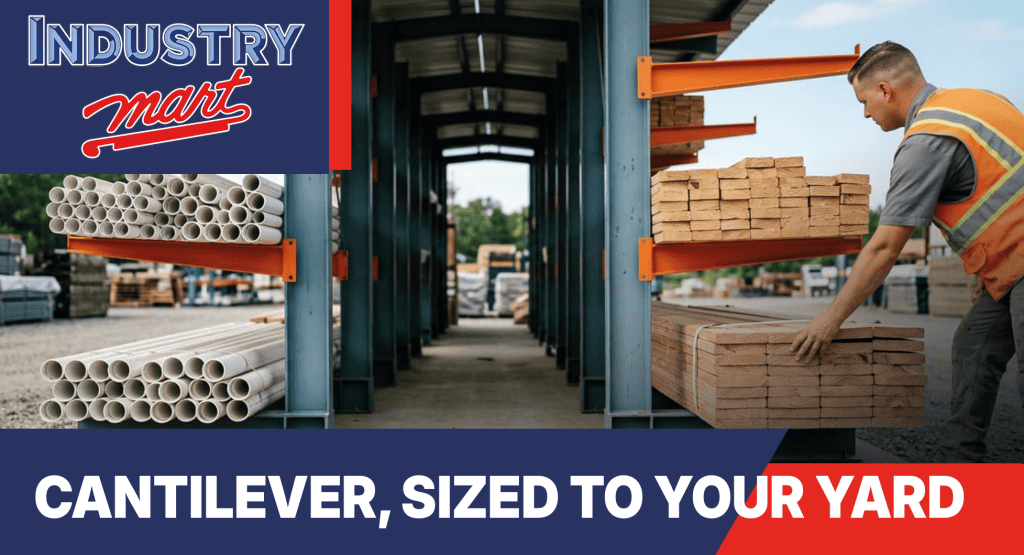
Long product breaks pallet rack in one specific way: the front beam is in the way. A sixteen foot bundle of 2x4s cannot go into a bay with a column every eight feet, so it ends up on the floor. Cantilever puts the column behind the load. What follows is lumber and pipe as two different arm problems, and the single or double-sided decision after that.
Key Takeaways
- Single-sided cantilever goes against a wall. Double-sided goes in the middle of the floor and stores from both aisles on one set of columns.
- Arm spacing is set by the product, not the rack. Lumber sags between arms; pipe rolls off them. The two need different answers.
- Arm capacity drops as arms get longer. On common systems a 36 inch arm carries more than a 48 inch arm on the same column.
- Cantilever anchors to concrete, not asphalt or gravel. That rules out a lot of yards until a pad goes in.
- Here is the part lumber yards learn the hard way: the load has to span at least two arms, and long product tends to want three.
- And if the product is steel, the whole system gets heavier, base to column to arm, before anything else gets decided.
Lumber Wants Arms Close Together
In cantilever rack lumber storage, dimensional lumber, plywood lifts and sheet goods share one problem: they bend. A unit of 2x4s spanning too far between arms bows in the middle, the strapping loosens, and the pieces on top start to walk. The spacing that prevents that is closer than what a catalog draws, because catalogs draw arms at the widest spacing the column allows and lumber wants the closest the load can afford.
The working rule is that any unit rests on at least two arms, with the count set by how much the load deflects between them rather than by a fixed length, and long product usually ends up on three. Overhang past the end arms stays short. Sheet goods are the strictest case, since plywood and OSB have little stiffness across the grain and droop between two arms even in short lengths. Yards that store sheets flat on cantilever run arms tight or add a deck across them.
The other lumber question is weather, because a lot of Tennessee lumber lives outside. Cantilever takes a roof system on the top arm level, but the base still sits on concrete. IndustryMart’s own product page puts it plainly: cantilever should be anchored to a concrete pad and cannot be placed on asphalt or gravel. So the first question for a yard is not which rack: how much of the yard is on a pad?
Pipe and Conduit Want the Ends Controlled
Pipe, tubing and conduit do not sag the way lumber does. What they do is roll. A bundle of EMT sits fine on straight arms until somebody pulls two sticks out of the middle and the rest settle sideways. That is why arms come with a lip or a pin at the tip on systems built for round product, and why some operations use inclined arms so the load rests against the column instead of the tip.
Conduit and pipe also come in more sizes per foot of aisle than lumber. A plumbing or HVAC distributor might run twenty diameters across three wall types, which is a lot of arm levels. Columns are punched in small increments, commonly every three inches, so arm heights get set to each bundle instead of to a fixed shelf spacing. That is where cantilever earns its keep against pallet rack for this market.
Steel is the heaviest case and it changes the whole system, not just the arms. Bar stock and structural shapes push the load per arm past what light and medium cantilever carry, and the base and column have to match. On a typical heavy system a 36 inch arm is rated higher than a 48 inch arm on the same column, so shorter arms with the load pushed toward the column carry more. For a steel service center that arithmetic matters more than height: what is the heaviest single bundle you will ever set on one arm?
Single-Sided or Double-Sided Is a Floor Question
A single-sided cantilever has arms on one face of the column and a base that extends behind it for stability. It goes against a wall, because the back is dead space anyway, and it is the answer when long product lives along the perimeter. A double-sided unit puts arms on both faces of the same column with a base that extends both ways, so one row of columns stores from two aisles. It goes in the middle of the floor, and per foot of column it is the denser of the two.
The decision is where the row will stand, not what it will hold. A double-sided run against a wall wastes half its arms. A single-sided run in the middle of a floor wastes half its aisle. Buildings with real volume of long product tend to end up with both, single along the walls and double down the middle, and the layout question becomes how many aisles the forklift needs and how wide.
Columns on many systems are punched on both faces, so a single-sided unit can sometimes be converted to double-sided later by swapping the base and adding arms, where capacity allows. That lets a yard start against the wall and grow into the floor. We design single and double-sided cantilever in light, medium and heavy duty, roll-formed or structural, and the right one is generally clear from the product list and a sketch of the floor.
Why This Is a Tennessee Problem
Long product is a large part of the warehouse market here because the material itself is a large part of the economy. Tennessee’s forest industry supports 91,000 jobs and generates $29.1 billion in output, about three percent of the state economy, and the state ranks among the top producers of hardwood lumber in the country. That lumber gets sawn, dried, graded and stored before it moves, and each of those stops is a cantilever rack or a pile on the ground.
Add the trades on the other side of the market, plumbing and HVAC distributors with pipe and duct, electrical supply with conduit and strut, steel service centers with bar and tube, and long product is a large share of what sits in Tennessee warehouses. Most of it wants the same thing: a column behind the load and arms where the product needs them. Walk into any plumbing supply in the state on a Monday morning and you will see it: twenty diameters of pipe, three wall types each, and a counter guy who knows which arm level holds the one you asked for without looking.
The site work is what trips up a first installation. Cantilever is tall, top heavy when loaded on one side, and the base carries the overturning load of the arms above it, which is why installation includes anchoring the base to the slab. A yard that has run on gravel for twenty years pours before it racks. How much of your long product could go vertical if the pad were there?
Frequently Asked Questions
Can cantilever rack go outside?
Yes, and lumber yards run it outside routinely, with or without a roof system on the top arm level. Galvanized or coated finishes hold up better, the base still needs concrete, and the roof has to be engineered for the wind and snow load at the site.
How tall can cantilever go?
Common stock heights run 8, 12 and 16 feet, with taller columns available on order. The practical ceiling is set by the forklift’s reach and by the base, since a taller column loaded on one side puts more overturning load on the anchors, and outdoor units also answer to wind.
Can I mix lumber and pipe on the same run?
On the same column, yes, at different arm levels. Set each level to the product it holds and treat the lip or incline as a per-level decision, not a system-wide one.
Is used cantilever available?
Sometimes, mostly from yards that closed or moved, and the base and column are what to inspect.
Talk to Somebody Who Has Been Designing Cantilever for Forty Years
IndustryMart’s experts have been designing cantilever systems for over 40 years, in light, medium and heavy duty, single and double-sided, roll-formed and structural, for sheet metal, lumber, metal and PVC pipe, vinyl siding and furniture. We deliver and install throughout the Southeast and mid-Atlantic from a 30,000 square foot showroom in Cookeville.
Send us your product list with lengths and bundle weights, and a sketch of where the row will stand. Ask for a quote on cantilever rack or call 931-537-3161 and we will size the arms to what you store.
Measure the Product Before You Measure the Rack
Cantilever rack lumber storage starts with the product, not the rack. Write down three things for each product: the longest length, the heaviest bundle, and whether it bends or rolls. Then mark which rows will stand against a wall and which in the open. Those answers set arm spacing, arm length, duty rating and the single or double decision before anybody quotes a column.
The rack does not care how long the product is. It cares where the weight sits on the arm.
Related Articles
- Teardrop vs Structural Pallet Rack: Which One Fits Your Warehouse, on the roll-formed and structural steel that cantilever is also built from.
- Boltless Shelving vs Pallet Rack: Which One Does Your Storage Need, on choosing a storage system by what loads it rather than by price.