
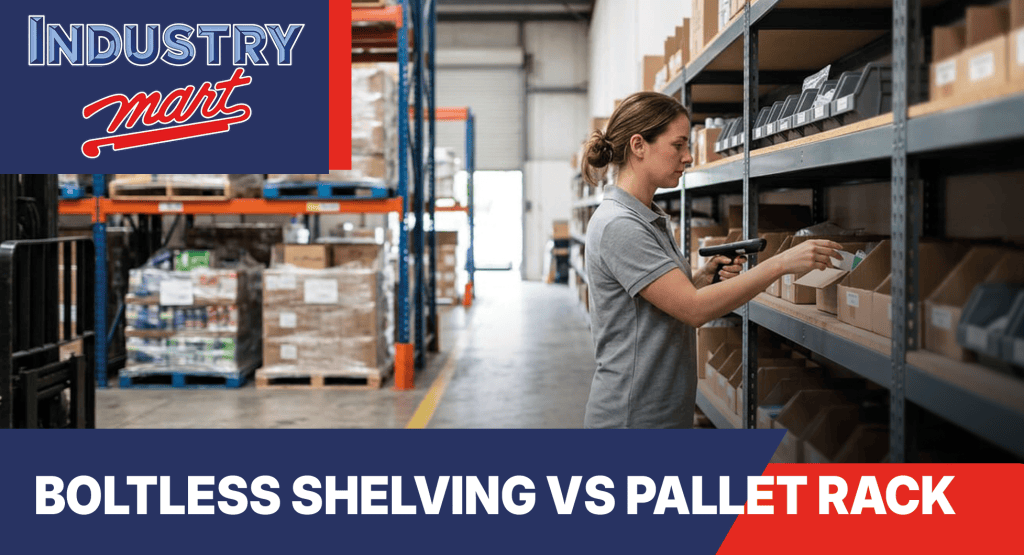
What touches the shelf decides this.
Not the weight of what you store, not the size of the building, not the budget. If a person’s hands put the product on the shelf and take it off, you are shopping for shelving. If a forklift does, you are shopping for pallet rack. A lot of wrong purchases in this category come from answering a different question first, usually price, and discovering the real one after the steel is standing.
This is the boltless shelving vs pallet rack decision as it plays out for small businesses and hand-picking operations: the three ways it goes wrong, the line between the two systems that does not move, the middle option many catalogs skip, and how to run both in the same building without one of them getting hurt.
Key Takeaways
- Hands load shelving. Forklifts load rack. That line is the whole decision.
- Boltless shelving assembles with a rubber mallet, adjusts in small increments, and carries a few hundred to about 1,500 pounds per shelf depending on the line.
- Pallet rack carries thousands of pounds per level and is built to be loaded by a forklift. Shelving is not, and it does not meet one gracefully.
- Wide span sits in between: rack-style frames, hand-loaded shelves, for the loads that outgrew rivet shelving.
- Many operations end up with both. The mistake is not owning two systems, it is putting the wrong one where the forklift drives.
The Three Ways This Purchase Goes Wrong
The first is buying pallet rack for a hand-picking operation because it looked like the serious choice. Beam levels on pallet rack are set for pallets, so the lowest shelf is at the floor and the next one is four feet up. A person picking cartons off that level works bent over or on a ladder, and the space between levels, sized for a pallet, holds air above every carton. The rack is stronger than the job needs and worse at the job than shelving would be.
The second is buying boltless shelving for a job that turns out to involve a forklift. It usually happens by drift. The shelving goes in for hand-picked parts, the operation grows, somebody starts staging pallets in the same aisle, and one day a truck backs into a post that was not designed to be touched by anything heavier than a hand. Rivet shelving is not rated for impact, and a bent post on a loaded unit is a problem that does not wait.
The third is buying one system for a building that needs two, and then trying to make it do both. That one usually costs the most because it gets fixed by buying the other system anyway, after the first one has already been installed in the wrong place.
The Line That Does Not Move
IndustryMart’s own guidance puts it in one sentence: pallet rack is designed for forklift-loaded pallets, and shelving is for lighter-weight hand-loading. Any boltless shelving vs pallet rack chart you will find is a set of consequences of that one line.
Boltless shelving, sold as rivet rack in many catalogs, goes together without tools. Posts have keyhole slots, beams have rivets that drop into them, and a rubber mallet seats the connection. Shelf heights adjust in small increments, which matters for hand-picking because the shelf goes where the product is, not where a pallet would be. Capacity per shelf runs from a few hundred pounds on light lines to around 1,500 on heavy industrial rivet shelving, with particleboard, steel or wire decks. Standard units run about seven feet high because that is what a person can reach.
Pallet rack is a different machine. Uprights and beams are sized for a full pallet per position, beam levels carry thousands of pounds, and the frames assume a forklift will work in front of them, which is why column protectors are part of the system. It goes as tall as the building and the lift allow. What it does not do well is hold a single carton at hand height, because nothing about it was designed with a hand in mind.
The Middle Option Many Catalogs Skip
Between rivet shelving and pallet rack there is a third thing, and for a lot of small operations it is the right answer. Wide span shelving uses rack-style uprights and beams with shelf decking across them, built for hand-loaded product that is too heavy, too long or too bulky for rivet shelving. Tires, rolls, cases of liquid, drums on their side, anything a person can still move but that would sag a light shelf.
It also stands up to a busy picking area without needing a forklift to justify it. The frames are heavier than rivet posts, the beams are rated well above a hand-loaded shelf, and the surface can be wire deck for visibility or solid for small parts.
The practical test for wide span is a case of product a person can lift but would not want to lift onto a light shelf twice a day. If your inventory has a lot of that, rivet shelving will fail slowly and pallet rack will waste the vertical space. See the industrial shelving we stock, steel, rivet rack, wire and wide span, new and used, and we can walk through which of the three your product actually needs.
Running Both in One Building
Operations that grow past a storage room usually end up with both systems, and that is the correct outcome. The question is where the line between them goes on the floor. The rule that holds up is simple: rack lives where the forklift lives, and shelving lives where it does not. If a truck has a reason to drive down an aisle, whatever is in that aisle needs to be pallet rack with post protectors, or the aisle needs to be closed to the truck.
The common layout in a small distribution or e-commerce operation is pallet rack for reserve stock on the dock side, and a shelving pick area, rivet or wide span, on the far side where product gets broken down and picked by hand. A replenishment path connects the two, and the forklift stops at the edge of the pick area.
This is where the two systems stop competing and start working together, and it is the situation most of this state’s businesses are in. Tennessee runs largely on operations at this scale: 741,196 small businesses make up 99.5 percent of Tennessee businesses and employ 41.5 percent of the state’s workers, and many of them store product in a back room, a storage bay or a small warehouse where one person and a hand truck do the moving. That is shelving country, with a few bays of rack by the door.
Frequently Asked Questions
Can I use pallet rack as shelving?
You can, and people do, usually by adding wire decking and setting beams closer together. It works for heavy hand-loaded product, but it is an expensive way to get a shelf, and beam increments are coarser than rivet shelving. If nothing on it will see a forklift, wide span does the same job for less.
How much weight can boltless shelving hold?
It depends on the line. Light-duty rivet shelving holds a few hundred pounds per shelf; heavy industrial rivet rack from manufacturers like Tri-Boro is rated up to about 1,500 pounds per shelf evenly distributed. The unit capacity is lower than the sum of the shelves, so check both numbers.
Do I need to anchor boltless shelving?
Tall units, units in seismic areas and anything loaded heavy should be anchored or tied together, and local code may require it. A loaded seven foot unit that is not anchored can tip if it is pulled on or bumped, and tying units back to back or to the wall is cheap insurance.
Is used shelving worth buying?
Yes for steel and rivet shelving, which is simple, durable and easy to inspect. Check that posts are straight, that rivets and slots are not deformed, and that particleboard decks are not swollen. New decks on used frames is a common combination.
What if my product is heavy but I still pick by hand?
That is the wide span case. Rack-style frames with hand-loaded shelves handle heavy cases, rolls and long items without a forklift, and they are the usual answer when rivet shelving starts to sag.
Talk to Somebody Who Stocks All Three
IndustryMart has been outfitting Tennessee businesses since 1979 out of a 30,000 square foot showroom in Cookeville, with truckloads of new and used shelving in stock, from a few sections for a storage room to thousands of units for a new warehouse. We carry steel shelving, rivet rack boltless shelving, wire shelving and wide span, along with new and used pallet rack, and we design layouts that put each one where it belongs.
Tell us what you store, who moves it, and whether a forklift is ever in the picture. Ask for a quote on shelving or rack or call 931-537-3161 and we will help you draw the line.
Answer the Forklift Question First
Walk your floor and mark every aisle a truck drives down. That is your rack. Everything else is shelving, and the only remaining question is whether your product is light enough for rivet shelving or heavy enough for wide span. Price comes last, because the wrong system at the right price is still the wrong system.
Steel does not know what you paid for it. It only knows what you put on it and what hit it.
Related Articles
- Liquor Store Shelving Layout: How to Plan a Store That Sells More, on heavy duty boltless shelving in a retail floor where every load is hand-placed.
- Pallet Rack Wire Decking: Sizes, Capacities, and How to Choose the Right Deck, on the decking that goes on both rack and wide span.